
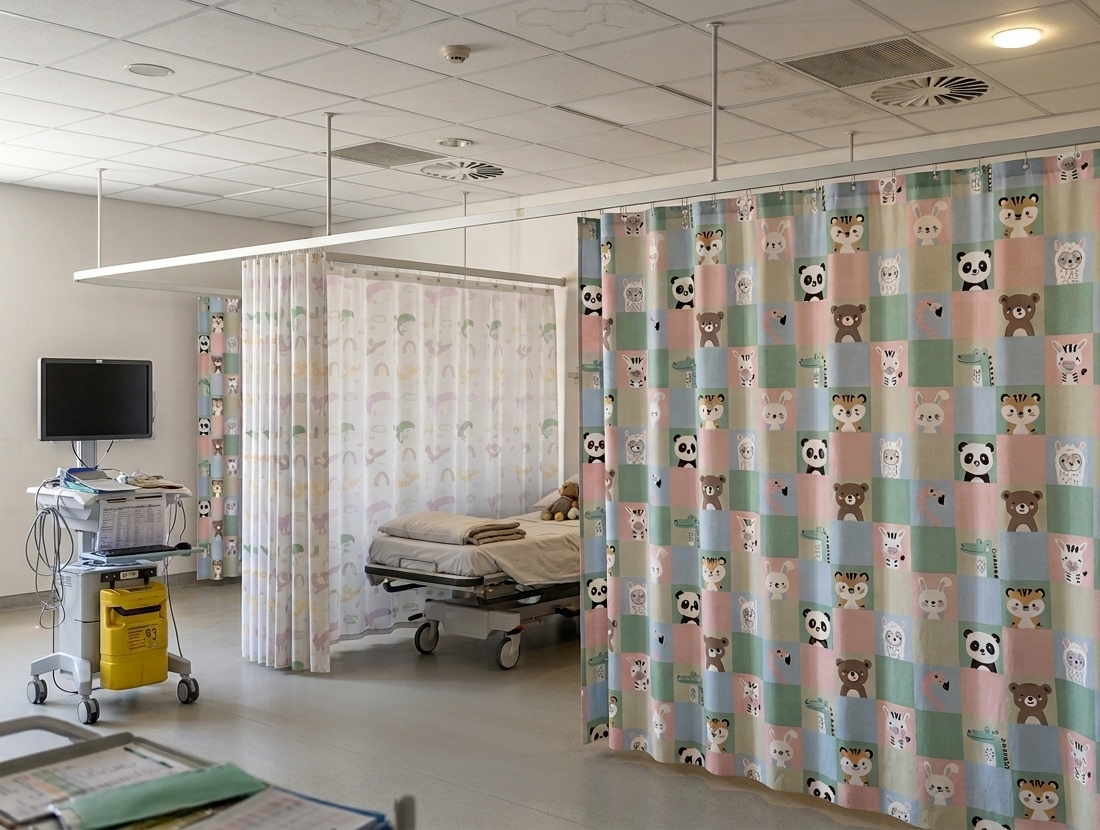
Privacy curtains and infection control: what the evidence suggests
Privacy curtains in hospitals and clinical facilities are handled frequently by clinicians, patients, and visitors. In many facilities, however, those curtains follow a laundry schedule rather than being replaced after each patient or episode of care.
Studies have identified contamination of privacy curtains with organisms such as MRSA, VRE, and other clinically relevant bacteria. It is worth noting that evidence is largely based on environmental sampling and contamination studies rather than direct causal healthcare-associated infection (HAI) attribution in all settings. Nevertheless, reusable curtains that accumulate contamination between laundry cycles are a recognised area of interest for infection control teams. For example, a 2018 risk assessment from National Cancer Centre Singapore identified reusable curtains as a potential cross-contamination risk factor in clinical environments.
For infection control teams, laundering schedules alone are difficult to rely on as a control measure. In addition, staff who handle curtains during removal face their own exposure risk.
What is a healthcare-associated infection (HAI)?
A healthcare-associated infection is an infection that a patient acquires during the course of receiving healthcare treatment and that was not present or incubating at the time of admission. HAIs are a significant cause of patient harm in Australian hospitals, and reducing their incidence is a priority under the National Safety and Quality Health Service (NSQHS) Standards.
Ultra-Fresh built-in antimicrobial technology
Midmed disposable curtains use Ultra-Fresh built-in antimicrobial technology, incorporated into the polymer structure of the non-woven fabric at the point of manufacture, not sprayed on. As a result, the antimicrobial active components distribute throughout the whole curtain and remain effective for its entire lifespan, without washing off, wearing away, or leaching out.
Ultra-Fresh technology works at a cellular level to continually disrupt the growth and reproduction of microorganisms. Independent testing to ISO 20743 (antibacterial activity of textile products) and ISO 18184 (antiviral activity of textile products) recorded log reductions against MRSA (3.60), E. coli (4.40), VRE (3.30), Ps. aeruginosa (4.30), and K. pneumoniae (5.90).
In addition, antiviral testing recorded a 99.99% active value against Human Coronavirus (HCoV-229E) and H1N1 Influenza A. Three-year durability testing confirmed the curtains still achieve up to 99.99% kill rate after three years of use. Furthermore, the technology holds TGA approval and Oeko-Tex certification, with no allergic risk identified, and is safe for children.
The Australian Commission on Safety and Quality in Health Care sets requirements for preventing and controlling healthcare-associated infections through governance and environmental infection control systems under the NSQHS framework. Environmental controls, including surfaces and furnishings that may harbour pathogens, are part of the scope.
Source: ACSQHC, NSQHS Standards, Standard 3: Preventing and Controlling Healthcare-Associated Infection
Material, installation, and operational considerations
Midmed disposable curtains consist of 100% recyclable polypropylene non-woven fabric. They are flame retardant and SGS-tested to Australian standard AS 2755.2-1985 and New Zealand standard AS/NZS 1530.3: 1999. Integrated hooks fit most existing hospital cubicle tracks in eyelet fit configuration. Colour options are Medical Blue, Light Blue, and Cream.
Reusable curtain laundry carries a significant and often underestimated operational cost. Each laundry cycle requires staff time to remove, bag, transport, and rehang curtains, as well as manage bay coverage while curtains are out of service. Where laundering is offsite, turnaround time increases and logistical coordination multiplies. These costs recur on every cycle, for every curtain, across every ward.
To support replacement tracking, each Midmed disposable curtain includes two permanent heat seal self-auditing labels. Staff can check the date at a glance without searching records or asking colleagues, saving time and removing guesswork from the replacement schedule.
Curtains fold back into a compact pleated stack when not in use. The surface wipes clean for dust or minor stains. Unless contaminated, they go out as non-clinical waste.
Recommended changeover frequency
The following table draws from the Midmed curtain changeover guidelines and shows recommended replacement frequency by risk area, alongside reusable curtain changeover for comparison.
| Area | Midmed Disposable Curtains | Reusable Curtains (comparative) |
|---|---|---|
| Very High Risk Outbreaks of infectious diseases |
Change immediately and upon patient discharge | Change immediately and clean upon discharge |
| High Risk ICU, HDU, Burns, Renal, Day Surgery, Operating Suites, Emergency Wards, Oncology, MRO wards |
Annually, or if visibly soiled or torn | Monthly, or upon discharge if MROs present; immediately if visibly soiled |
| Significant Risk General wards |
Annually, or if visibly soiled or torn | Every six months, or immediately if visibly soiled |
| Low Risk Rehabilitation, long-term care, nursing homes, office-based practice, medical centres |
Every two years, or if visibly soiled or torn | Annually, or immediately if visibly soiled |
Change curtains immediately if blood or body fluid soiling occurs. Unless contaminated, dispose of as non-clinical waste. Staff can wipe the surface clean with a damp cloth for dust or minor stains during use.
Paediatric options
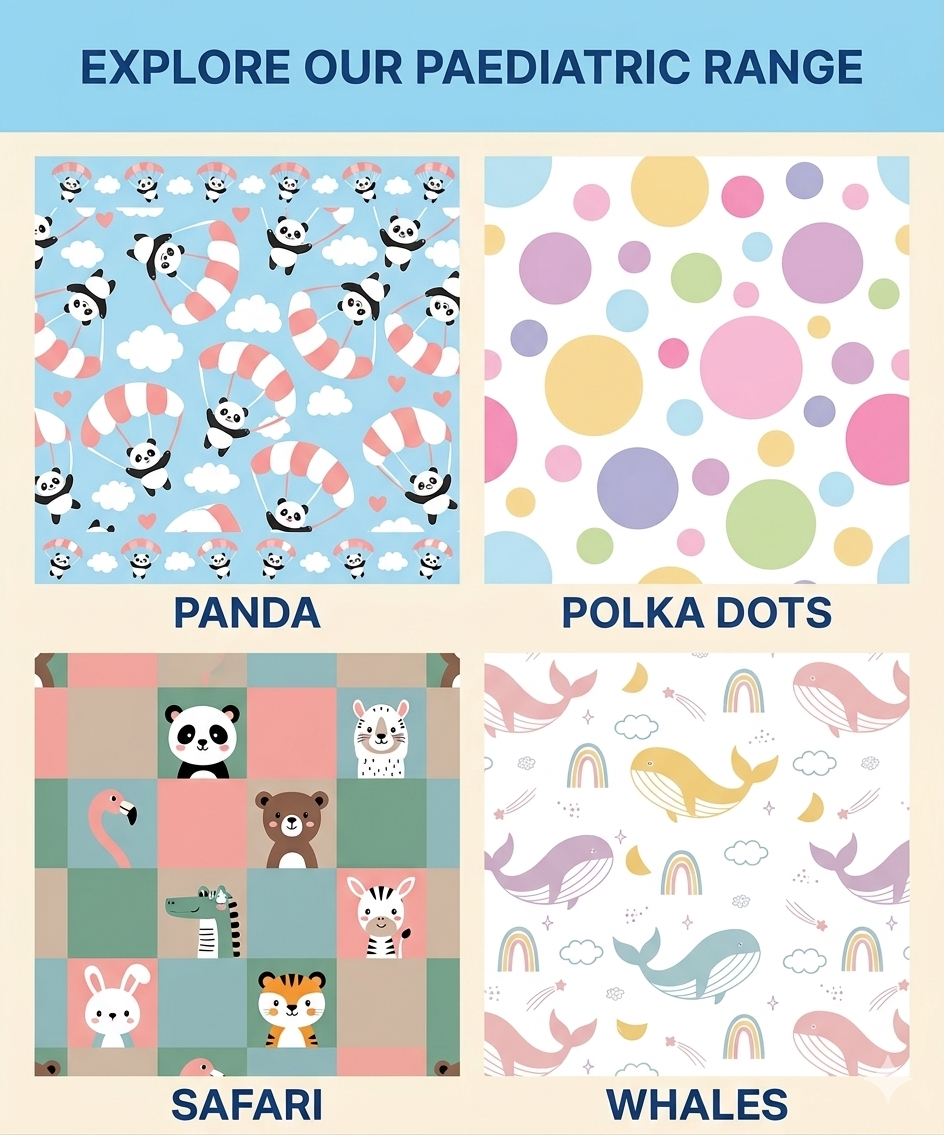
Midmed curtains are available in four paediatric designs: Panda, Polka Dots, Safari, and Whales. Familiar, child-friendly imagery can help reduce distraction and anxiety for young patients in clinical environments, contributing to a better experience for patients and families. All paediatric curtains carry the same Ultra-Fresh built-in antimicrobial treatment and are TGA-approved safe for children.
Midmed curtain range: available options
The following curtain products are available through Midmed. Confirm current availability with your representative before ordering:
- ✓ Midmed antimicrobial disposable curtains (Medical Blue, Light Blue, Cream; eyelet fit; 7.5m and 4.5m widths; 100% recyclable polypropylene; Ultra-Fresh built-in technology; flame retardant; fire tested AS 2755.2-1985)
Drop selection: 2.5m with mesh top for ceiling-mounted tracking — mesh allows light, air, and water circulation to meet fire codes. 2.0m without mesh for suspended curtain tracking. - ✓ Midmed paediatric curtains (Panda, Polka Dots, Safari, Whales; same Ultra-Fresh antimicrobial treatment; safe for children; TGA-approved technology)
- ✓ Alternative range (Pine Tree, Geometric; same specifications as standard range)
Frequently asked questions
Have reusable privacy curtains been associated with infection risk?
Studies have identified contamination of reusable privacy curtains with organisms including MRSA, VRE, and other clinically relevant bacteria. However, evidence is largely based on environmental sampling and contamination studies rather than direct causal HAI attribution in all settings. Infection control teams consider curtains a potential risk area. For example, a 2018 risk assessment from National Cancer Centre Singapore identified reusable curtains as a potential cross-contamination risk factor in clinical environments.
How does Ultra-Fresh antimicrobial technology work?
Manufacturers build Ultra-Fresh technology into the polymer structure of the non-woven fabric at manufacture, rather than applying it as a spray-on coating. It works at a cellular level to disrupt microbial growth and reproduction throughout the curtain's lifespan. In addition, it will not wash off, wear away, or leach out. Independent testing to ISO 20743 and ISO 18184 confirms antibacterial and antiviral efficacy.
Are Midmed disposable curtains recyclable?
Yes. Midmed disposable curtains consist of 100% recyclable polypropylene non-woven fabric. Unless contaminated, facilities dispose of them as non-clinical waste, which supports waste stream management within a sustainability framework.
Do the curtains fit existing hospital tracks?
Midmed disposable curtains fit most existing hospital cubicle tracks in eyelet fit configuration. However, hook type may vary by track. Speak with a Midmed sales consultant to confirm compatibility before ordering.
Where do disposable curtains fit within NSQHS infection control requirements?
The NSQHS Standards (Standard 3) set requirements for health services to maintain governance systems for preventing and controlling HAIs, including management of the clinical environment. As a result, disposable antimicrobial curtains may form part of a facility's environmental infection control approach. Specific compliance determinations should come from the facility's infection control and clinical governance teams with reference to the current NSQHS Standards.
Interested in evaluating Midmed antimicrobial disposable curtains for your facility? Our sales consultants can provide product information, confirm current availability, and arrange samples.