
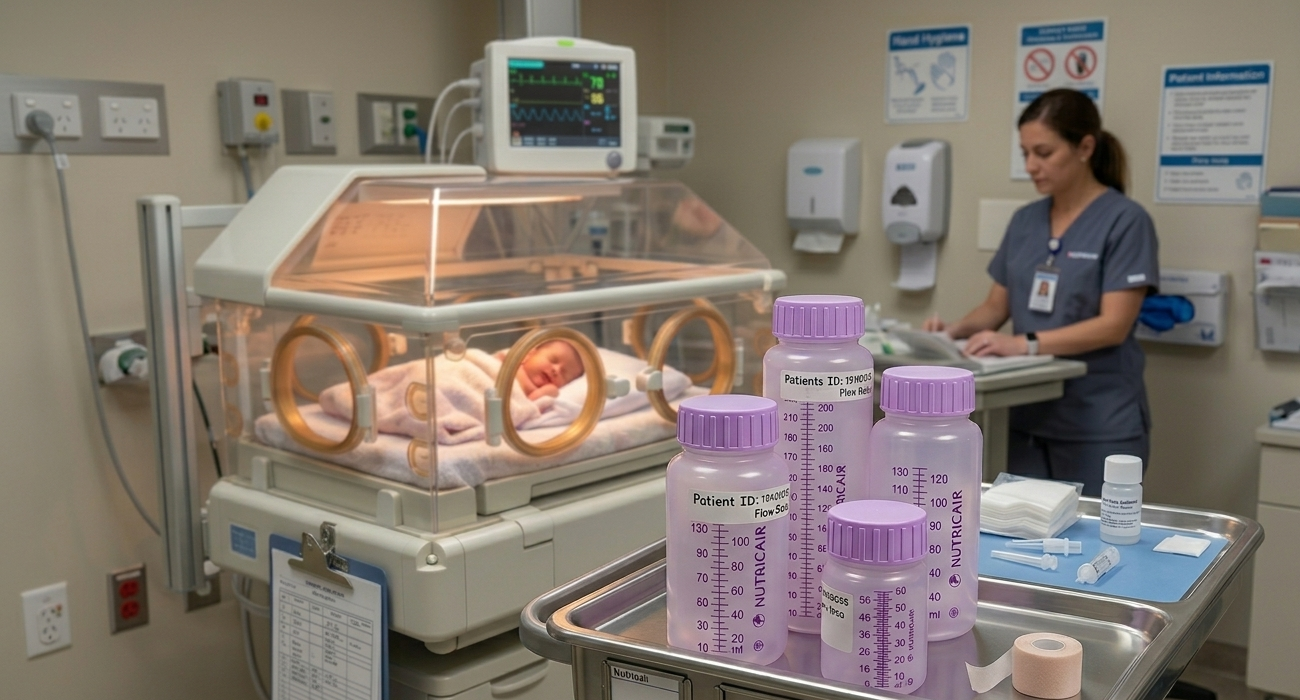
Why material and sterility standards matter in neonatal feeding
Neonates, particularly those in NICU settings, are among the most clinically vulnerable patients a hospital manages. Their immune systems are immature, their feeding tolerance is fragile, and the consequences of contaminated or chemically unsafe feeding equipment can be severe, and in some cases fatal.
Neonatal feeding decisions are shaped by a range of factors including hospital infection prevention requirements, breastfeeding support objectives, patient-specific clinical needs, and individual facility policy. Sterility at the point of use, BPA-free material construction, and latex-free certification are important procurement considerations when evaluating neonatal feeding bottles and accessories. They are not necessarily the only requirements a facility will apply, and procurement teams should review their own clinical standards alongside supplier documentation when making decisions.
BPA-free and latex-free construction in neonatal feeding products
BPA (bisphenol A) is a chemical used in some plastics manufacturing. While not universally banned, its use in clinical settings is subject to a voluntary phase-out and specific guidelines for high-risk environments. Australian NICUs prioritise BPA-free equipment due to the extreme vulnerability of preterm infants to endocrine-disrupting chemicals. BPA-free construction is now standard practice in infant and neonatal feeding products, and procurement teams should confirm BPA-free status directly with suppliers and review relevant documentation before clinical use.
Latex-free construction is also worth confirming. Latex allergies can present with serious reactions in both vulnerable patients and clinical staff, making latex-free equipment an important consideration for any neonatal or maternity setting.
Sterile, individually sealed neonatal feeding bottles: why single use matters
Reusable bottles in neonatal settings introduce decontamination steps that sterile, individually sealed, single-use bottles are designed to remove from the clinical workflow. In NICU, Special Care Nursery and maternity wards, where feeding regimens are closely managed and infection control is paramount, a sterile-from-packaging approach can support infection prevention processes by reducing a potential contamination step.
Nursing staff managing multiple neonates simultaneously benefit from feeding equipment that arrives sterile, requires no preparation, and is discarded after use, reducing the decontamination burden without compromising safety.
Feeding protocol consistency and contamination control are important components of neonatal care. Equipment that arrives sterile and ready to use supports safe feeding practices by removing a decontamination step that clinical staff would otherwise need to manage.
NutriCair: sterile neonatal feeding bottles available through Midmed
The NutriCair range (by Cair LGL) provides BPA-free, sterile single-use feeding bottles designed for use in NICU, Special Care Nursery and maternity settings, available in 60ml, 130ml, and 240ml.
- ✓ NutriCair 60ml Baby Bottle with Cap (CA.NCB1060A) - sterile single use, BPA-free, polypropylene reservoir with graduated scale. Suitable for very low-volume neonatal feeds. Available through Midmed.
- ✓ NutriCair 130ml Baby Bottle with Cap (CA.NCB1130A) - sterile single use, BPA-free, polypropylene reservoir with graduated scale. Designed for NICU, Special Care Nursery and maternity ward use. Available through Midmed.
- ✓ NutriCair 240ml Baby Bottle with Cap (CA.NCB1240A) - sterile single use, BPA-free, polypropylene reservoir with graduated scale. Suitable for maternity settings. Available through Midmed.
- ✓ NutriCair Bottles with Cap and Ring (CA.NCBB1060A/160, CA.NCBB1130A/130, CA.NCBB1240A/90) - available in 60ml, 130ml, and 240ml. Watertight, suitable for pasteurisation and freezing. Available through Midmed.
Speak with a Midmed sales consultant to confirm current availability and to discuss volume requirements for your ward or facility.
Hospital lactation programs: supporting expressed milk for NICU and maternity patients
Neonatal feeding in hospital settings is not limited to bottle feeding. When an infant is premature, admitted to NICU, or temporarily unable to feed directly at the breast, supporting the mother in establishing and maintaining milk supply through expressing is an important part of clinical management. Reliable equipment is a prerequisite for program consistency.
Breast milk is considered the gold standard for neonatal nutrition. For premature and low birth weight infants in particular, it provides immunological protection, nutritional suitability, and digestibility advantages over formula. The Australian Breastfeeding Association and international breastfeeding organisations support the provision of expressed breast milk for infants in NICU and Special Care Nursery settings where direct breastfeeding is not immediately possible.
Why breast milk matters for premature and NICU infants
Breast milk is considered the gold standard for neonatal nutrition. For premature infants and neonates in intensive care it provides immunological factors that formula cannot replicate, is more easily digested by immature gastrointestinal systems, and supports growth and neurological development. The Australian Breastfeeding Association and WHO guidance both highlight the importance of supporting mothers to express and provide breast milk when infants cannot feed directly at the breast.
Hospital lactation programs depend on reliable breast pump systems and hygienic accessory sets designed for single-patient use. The Ameda HygieniKit® Universal Kit (SKU: AM.17456) is a sterile, single-use double pumping kit. It includes 25mm flanges, 120ml bottles, silicone valves, universal diaphragms, and silicone tubing with adapters. BPA-free and DEHP-free. Features a patented airlock barrier that prevents air flow between expressed milk and tubing, keeping tubing dry and eliminating the need to clean or replace it. Compatible with Ameda Platinum, Elite, Joy, and Joy Plus breast pumps. Midmed is the Australian supplier for Ameda. Confirm compatibility with your existing pump infrastructure when evaluating.
What procurement teams should confirm
When evaluating neonatal feeding equipment for NICU or maternity ward procurement, the following questions are worth confirming with your supplier or representative before finalising an order.
- ✓ Sterility: is the product individually sterile-packaged and sealed at the point of manufacture?
- ✓ Materials: has BPA-free construction been confirmed by the manufacturer?
- ✓ Latex-free: does the manufacturer confirm this?
- ✓ Intended use: does the manufacturer documentation confirm the product is designed for neonatal use?
- ✓ Shelf life: is current stock within the stated shelf life?
- ✓ Volume and delivery: are lead times confirmed for your ward's ordering cycle?
Midmed sales consultants can assist with product selection, specification confirmation, and availability enquiries for the NutriCair range.
Frequently asked questions
Why must neonatal feeding bottles be sterile and BPA-free?
Neonates, particularly those in NICU settings, have immature immune systems that make them more susceptible to infection from contaminated equipment. BPA-free construction removes a chemical safety concern specific to infants. Together, these requirements reflect the higher clinical standard appropriate for the most vulnerable patient population in a hospital setting.
What is the NutriCair range and where is it available?
NutriCair is a range of BPA-free, sterile single-use feeding bottles of European manufacture, designed for use in NICU, Special Care Nursery and maternity settings. Available through Midmed in 60ml, 130ml, and 240ml formats, with cap-only and cap-and-ring configurations. The Ameda HygieniKit® Universal Kit (SKU: AM.17456) is also available through Midmed.
What pump accessories are available through Midmed for hospital lactation programs?
The Ameda HygieniKit® Universal Kit (SKU: AM.17456) is a sterile, single-use double pumping kit including 25mm flanges, 120ml bottles, silicone valves, universal diaphragms, and silicone tubing with adapters. BPA-free and DEHP-free, with a patented airlock barrier that keeps tubing dry. Compatible with Ameda Platinum, Elite, Joy, and Joy Plus breast pumps. Midmed is the Australian supplier for Ameda.
Why is breast milk important for premature and NICU infants?
Breast milk is considered the gold standard for neonatal nutrition. For premature and medically vulnerable neonates it provides immunological protection, nutritional support suited to their developmental stage, and digestibility advantages that formula cannot replicate. The immature gastrointestinal systems of premature infants are better supported by breast milk than formula. The Australian Breastfeeding Association, the WHO, and the NHMRC Infant Feeding Guidelines all support providing expressed breast milk to NICU infants where direct breastfeeding is not possible. Hospital lactation programs and expressing equipment play a practical role in making this possible when mothers and infants are separated or when infants cannot feed at the breast directly.
How do I confirm current availability of neonatal feeding products at Midmed?
Speak with a Midmed sales consultant on 1300 643 633 (Monday to Friday, 8:00am to 4:30pm AEST) or submit an enquiry through the contact page at midmed.com.au/contact. Your consultant can confirm current stock levels and assist with volume and delivery requirements.
To order or confirm availability of the NutriCair range, speak with a Midmed sales consultant.