Pelvic fractures in the field: haemorrhage control before surgical handover

Pelvic fractures are a major contributor to preventable death in major trauma, primarily due to haemorrhage. An unstable pelvic ring can create a large potential space for blood loss, making early stabilisation critical.
Pelvic binders are applied as part of haemorrhage control in suspected pelvic injury, with early use established as best practice in pre-hospital and hospital care. When applied early and correctly over the greater trochanters, a pelvic binder helps reduce pelvic volume and supports haemorrhage control.
However, correct placement is not always achieved. Published studies show that a substantial proportion of pelvic binders are positioned incorrectly, with reported misplacement rates around 30–40%. This has direct implications for both haemorrhage control and mechanical stability.
What pre-hospital teams need from a pelvic binder
In the field, equipment needs to work quickly, reliably, and with minimal complexity. For a pelvic binder, that means:
- Simple, consistent application
The greater trochanter is the standard reference point. A well-designed binder should make correct placement straightforward, even under pressure, reducing the risk of suboptimal positioning. - Reliable tension during transport
A binder needs to maintain circumferential compression once applied. In a moving environment, that stability supports pelvic alignment and assists with haemorrhage control. - Compatibility with imaging and ongoing care
Equipment should be able to remain in place through assessment, transfer procedure, and imaging when required, without interrupting care.
The T-POD R is designed for pre-hospital and hospital use, with a circumferential adjustment system and imaging compatibility. Available through Midmed.
From field to ward: the handling challenge after binding
A patient with a pelvic binder in place still requires careful handling at every transition point, from scene to ambulance, ambulance to ED, and through to imaging or theatre.
Unnecessary movement, including log rolling, may disrupt clot formation and worsen haemodynamic instability, reinforcing the need for controlled transfer techniques.
Some transfer methods can increase handling complexity or introduce unnecessary movement, which is not ideal in a patient who may already be haemodynamically unstable.
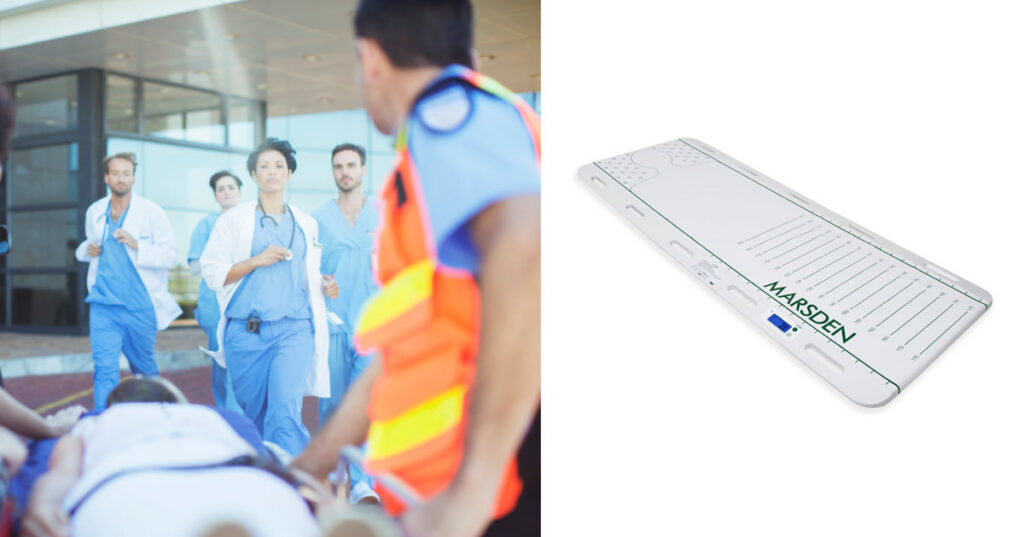
The Binder Lift and Binder Transfer Sheet are designed to support safer patient movement during these transitions. Used appropriately, they can help reduce disruptive repositioning and support controlled lateral transfers while maintaining patient alignment.
This is a systems issue. The strongest approach is to align pre-hospital and in-hospital equipment so the patient can move through care with minimal unnecessary handling.
Speak with your Midmed representative about clinical information, evaluation units, or pricing for the pelvic binder system.