Manual handling injuries in Australian hospital wards — what the WHS data shows and what ward teams can do

Manual patient handling equipment has improved significantly over the past decade. But in many Australian hospital wards, the tools being used don’t always match the task at hand. Hover jacks, hover matts, pat slides, and slide sheets remain the workhorses of most patient handling programs, and they work well in the right scenarios. The problem is when they don’t.
Below are three real situations ward teams face regularly, what’s commonly being used, and where gaps exist.
Scenario 1: A patient falls in the bathroom and can’t get up
This is one of the most physically demanding situations a ward nurse or orderly encounters. The patient is on the floor, the space is confined, and the standard tools simply don’t fit.
What hospitals are currently using:
- Hover jacks and hover matts: designed for open floor space, these are awkward to position in a bathroom and require enough clearance to inflate properly
- Pat Slide: effective for bed-to-trolley transfers, but not designed for floor recovery in confined spaces
- Slide sheets: can assist but offer no structured lift and are difficult to position under a patient on a bathroom floor
The limitation is physical, not procedural. In a bathroom, there often isn’t enough room to set up equipment correctly and attempting to do so with the wrong tool increases risk for both patient and staff.
A purpose-designed option for this scenario:
The Patient Mover Sheet is built specifically for confined-space floor recovery. Unlike hover matts that require open floor area to inflate, it works on any floor surface and gives staff a secure, handled way to move a patient who cannot get up on their own.
Scenario 2: Lifting a patient who can’t lie flat
Not every patient can be transferred horizontally. Patients in a semi-reclined position (post-surgical, respiratory, or with spinal considerations) present a distinct challenge for standard lateral transfer equipment, which assumes a flat supine position.
What hospitals are currently using:
- Hover matts: function well for flat patients but are less effective when the patient must remain in a semi-reclined position
- Pat Slide and slide sheets: designed for horizontal movement and not suited to angled or semi-upright transfers
When the standard approach doesn’t fit the patient’s position, staff are often left to improvise, which creates manual handling risk and compromises the safety of the transfer.
A better fit for this scenario:
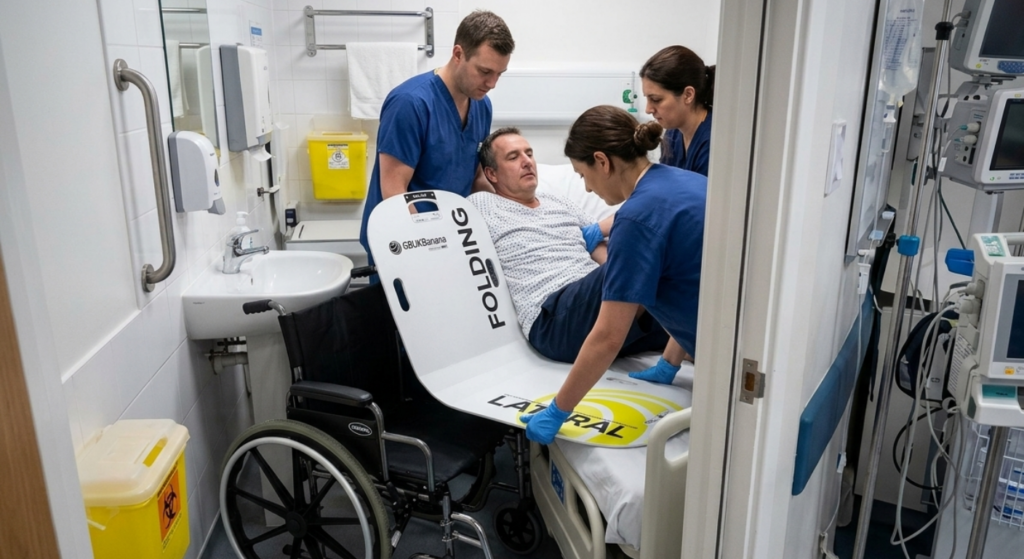
The Banana Board (available through Midmed, contact your rep) is designed for exactly this situation. Its curved profile accommodates the natural posture of a semi-reclined patient, allowing a supported transfer without requiring the patient to lie flat. This is a meaningful clinical difference when working with post-op or medically complex patients.
Scenario 3: Routine lateral transfers and repositioning
For standard bed-to-trolley transfers and in-bed repositioning, slide sheets remain a common and widely stocked option. Most wards already have them in some form. The question isn’t whether to use them, it’s whether what’s in stock is fit for purpose.
What hospitals are currently using:
- Reusable slide sheets: effective for general transfers but require laundering between uses, which adds infection control overhead
- Single-use disposable sheets: preferred in higher-risk infection environments but vary significantly in quality and value across suppliers
The Banana Slide Single Patient Tubular from Midmed is a single-use tubular slide sheet designed for lateral transfers and repositioning. Supplied in bulk, it suits high-volume ward environments where consistent infection control and ease of use are priorities. Speak with your Midmed rep to discuss volume options.
What this means in practice
The right equipment for patient handling isn’t one product; it’s having the right tool for each scenario. A slide sheet that works well for bed repositioning won’t help when a patient has fallen in a confined space. A hover matt designed for open floor areas won’t assist when a patient can’t lie flat.
Midmed’s range addresses three distinct gaps:
- Confined space floor recovery: Patient Mover Sheet
- Semi-reclined patient transfers: Banana Board (contact rep for availability)
- Routine lateral transfers and repositioning: Banana Slide Single Patient Tubular
To request datasheets, discuss clinical applications, or arrange an evaluation, speak with your Midmed representative.
Contact Midmed → midmed.com.au/contact